


Septic Systems in the White Mountains: What Every Land Buyer Must Know Before They Buy
Vacant land in the White Mountains can look like a bargain. Ten thousand dollars, twenty thousand dollars, sometimes less. But the price on the listing is only part of the story — and for many buyers, it is the smaller part. Before you can legally use that land, before you can connect an RV, before you can build a home, before the county will even allow power to run to the property, you will almost certainly need a permitted, inspected septic system. And in this region, that system can cost more than the land itself.
This article explains what septic systems are, what they cost in the White Mountains, what Navajo County and Apache County each require, and why cutting corners on any of this will come back to hurt you — at the worst possible time.
What a Septic System Is
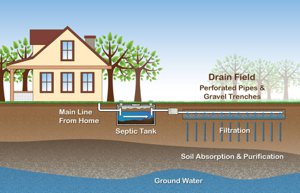
A septic system — also called an on-site wastewater treatment facility under Arizona law — is a privately owned system that treats and disposes of household wastewater on the property where it is generated. In most rural areas of the White Mountains, there is no municipal sewer connection available. That means every home, every legally occupied structure, every RV legally within set rules connected to a waste system, requires its own septic.
There are two broad categories of septic systems: conventional and alternative. Understanding the difference is critical for any buyer of White Mountains land, because the soil here does not always cooperate.
The Percolation Test: Where Your Costs Get Determined
Before any septic system can be designed or permitted, the land must be evaluated. A registered sanitarian or professional engineer performs what is called a percolation test — commonly called a perc test — along with a soil evaluation. The perc test measures how quickly water drains through the soil in the area where the septic system would be installed.
This test is not optional. It is required before a septic permit will be issued in either Navajo County or Apache County. And the result of that test determines everything that follows.
If the soil drains at an acceptable rate, a conventional septic system may be possible. A conventional system consists of a septic tank and a leach field — a series of underground trenches that allow treated wastewater to slowly disperse into the soil. These systems are the least expensive option.
If the soil fails the perc test — meaning it drains too slowly, or there is shallow rock, high groundwater, or other limiting conditions — a conventional system cannot be installed. The property will require an alternative system, also called an engineered system. And that changes the financial picture dramatically.
Conventional vs. Alternative Systems: The Cost Reality
Conventional septic systems in Arizona are sized based on the number of bedrooms and water-using fixtures in the home. A standard three-bedroom home requires a minimum 1,000-gallon tank. Installation costs for a conventional system in the White Mountains typically run in the range of $10,000 to $20,000, depending on site conditions and contractor.
Alternative systems — sometimes called engineered septic systems — are a different matter entirely. These systems are required when conventional drainfields will not work due to soil conditions, shallow bedrock, proximity to groundwater, or other site limitations. They may include aerobic treatment units, mound systems, drip irrigation systems, sand filters, or other engineered solutions. They require a licensed engineer to design them, county or state permitting, multiple inspections, and ongoing maintenance contracts.
In the White Mountains, alternative systems routinely cost between $20,000 and $70,000 or more. Apache County's own informational materials acknowledge that alternative systems can be very expensive, and list $20,000 as a starting point. In practice, buyers in our market frequently receive bids well above that figure, particularly on properties with difficult soil or terrain.
A buyer who purchases a $15,000 parcel expecting to park an RV (there are county regulations for such) and enjoy their land may be looking at $50,000 in septic costs before they can legally do anything with it. That is the math that the listing price does not show.
What Navajo County Requires
Navajo County is direct on this subject. The following requirements come directly from county sources.
A septic permit is required before a building permit will be issued. The county requires that the sewage system be available before construction begins. A soil test in the desired location for the system is required first. The system must then be installed and pass inspection before it is considered ready for use.
Electric power cannot be connected to vacant property without a valid primary dwelling and septic permit already in place. This surprises many buyers who assume they can at least run power while they plan. They cannot.
Proof of an approved septic system — or a letter of release from a sanitary district — is required when applying for a building permit. There is no workaround. The septic comes first.
The permit fee for a residential alternative system installation starts at $800, with additional fees depending on complexity. That fee covers the county's review and inspection — it does not include the cost of the system itself, the engineer's fees, the contractor, or the equipment.
Navajo County Planning and Development Services oversees septic system design and installation for both conventional systems and some alternative systems. Alternative systems that fall outside the county's delegated authority must be permitted through the Arizona Department of Environmental Quality (ADEQ).
For questions specific to your parcel, contact Navajo County Planning and Development Services at their Show Low office: 1100 E. Thornton Rd., Show Low, AZ 85901, phone (928) 532-6040.
What Apache County Requires
Apache County follows the same foundational framework. All on-site wastewater treatment facilities — every septic system, regardless of type — require a permit before installation. There are no exceptions.
Apache County's Environmental Health Division has delegated authority from the state to permit certain types of systems. Systems that use technologies outside that delegation must be permitted through ADEQ. Either way, the permitting process must happen before construction begins.
To obtain a septic permit in Apache County, the property owner must submit a Notice of Intent to Discharge along with plans, detailed drawings, site evaluation data, and the applicable fee. The county conducts a minimum of two inspections during construction. Once construction is complete and inspections are passed, the applicant submits a Request to Discharge for final approval.
Apache County also acknowledges plainly in its own published materials that sewer service is not available in most rural areas of the county, that soil conditions frequently prevent conventional systems from being installed, and that alternative systems can be very expensive.
Contact Apache County Environmental Health Division for parcel-specific information before making any purchase decision that depends on a septic system being feasible.
The RV Question: A Legal Septic Does Not Mean You Can Live There
This is one of the most common and costly misunderstandings we see in our market right now.
Buyers assume that if they install a legal, permitted septic system, they can connect their RV or travel trailer and use it as a residence. In most cases, that assumption is wrong — and it is wrong in ways that have real legal consequences.
In Apache County, RVs are classified as vehicles, not dwellings. They cannot be permanently hooked up to a septic system as a form of housing. In Navajo County, camping in a recreational vehicle on vacant property for more than 30 consecutive days in a calendar year is explicitly listed as a code violation — regardless of whether a septic system exists on the property.
We have already written in detail about the regulations governing RV use and camping on private land in Navajo and Apache Counties. Can I Live in My RV? If you have not read that article, we strongly encourage you to do so before purchasing any land with the intent of living in an RV, even temporarily.
The point here is this: a permitted septic system is a necessary condition for legal occupancy. It is not a sufficient one. There are additional zoning and land use requirements that must also be met, and meeting them takes time, money, and paperwork — well beyond the septic system itself.
The Unpermitted System Trap
We are seeing posts on local social media from people who have installed septic systems themselves — dropping a tank, running leach lines, and declaring the matter settled. The reasoning seems to be that they will deal with the permitting later, or that no one will notice, or that it works well enough for now.
There are several serious problems with this approach.
First, an unpermitted system is illegal. Both Navajo County and Apache County require permits and inspections. Installing a system without them is a violation of county ordinance and state law. Navajo County code enforcement explicitly lists failed or overflowing septic systems as an actionable violation.
Second, an unpermitted system is a health and environmental risk. Septic systems are regulated because improperly designed or installed systems contaminate groundwater and soil. A 75-foot leach line installed without engineering review, soil evaluation, or inspection may feel functional today and fail catastrophically later — on your property, or on your neighbor's.
Third, and most critically for buyers: an unpermitted system will surface at resale — and it will kill the deal.
Arizona state law requires that when a property with a septic system is sold, the seller must hire a qualified inspector to inspect that system within six months before the transfer of ownership. The inspector prepares a Report of Inspection that is provided to the buyer. This requirement applies to every real estate transaction — including transactions assisted by a real estate professional — and it applies to both conventional and alternative systems.
An unpermitted system has no permit number, no discharge authorization, no inspection record. It cannot pass a transfer inspection. A lender will not finance a property with an unpermitted septic system. A title company will flag it. The transaction will not close — or it will close with the seller required to bring the system into compliance at their own expense, which may mean tearing out what was installed and starting over.
The person who installed that 75-foot leach line without a permit is not just risking a fine today. They are creating a problem that will cost them, and potentially a future buyer, far more than the permitted system would have cost in the first place.
What to Verify Before You Buy
If you are considering purchasing land in the White Mountains — particularly vacant land at a price point that seems attractive — these are the questions that must be answered before you commit.
- Has a perc test been performed on this property? If not, one will be required before a septic permit can be issued. Soil conditions vary significantly across this region. A failed perc test can make a parcel unbuildable at any reasonable cost.
- If a perc test has been done, what were the results? Ask for the documentation. Results should be on file with the county.
- Is there an existing septic system on the property? If so, is it permitted? Ask for the permit number and verify it with the county. An existing system without a permit number is a red flag that must be resolved before purchase.
- If the property requires an alternative system, what is the estimated cost? Get actual bids from licensed septic contractors before closing, not after.
- What does the zoning allow? A legal septic system does not automatically authorize residential use, RV occupancy, or any particular land use. Zoning and land use must be verified separately.
- What are the CC&Rs or deed restrictions, if any? Some subdivisions impose additional restrictions on septic system types, RV use, or the timing of construction.
We have been serving buyers and sellers in the White Mountains for over 25 years. We have seen what happens when buyers skip these questions — and we have seen it happen to people who were not careless, just uninformed. The information above exists to close that gap.
If you have questions about a specific property, or you want to understand what you are actually buying before you sign anything, we are here. That is exactly what we do.
A note on terminology: You may see these systems referred to as alternative septic systems, engineered septic systems, or alternative on-site wastewater treatment facilities. These terms are generally used interchangeably. Arizona administrative code uses "on-site wastewater treatment facility" as the formal designation for all septic systems, conventional and alternative alike.